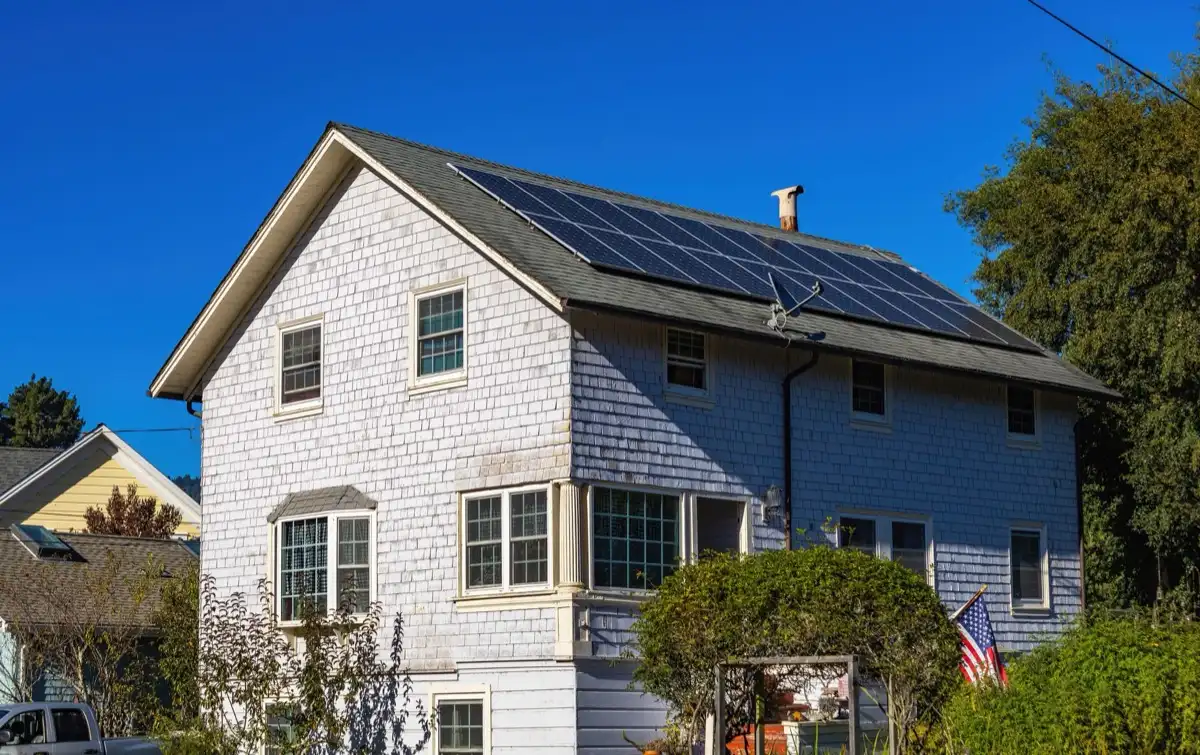
A soffit is the finished underside of your roof overhang — the surface above your head when you stand under the eave and look up. The fascia is the vertical board on the outer edge of that same overhang, the one the gutters are screwed to. Two planes, two jobs, and the two words get swapped daily by people who own both.
The distinction earns its keep for one reason. On a vented roof the soffit is the whole intake side of the attic, and a soffit vent painted shut or buried under insulation is a reliable way to cook a set of shingles from underneath.
Soffit and fascia, told apart for good
| Soffit | Fascia | |
|---|---|---|
| Plane | Underside of the overhang | Vertical, at the outer edge |
| What it does | Closes the eave, admits attic intake air | Closes the rafter ends, carries the gutter |
| Fixed to | Rafter tails, or lookouts back to the wall | The cut ends of the rafters or truss tails |
| Seen from | Underneath only | The street |
| Typical failure | Sagging, staining, pests, blocked vents | Rot at the back face, fixings letting go |
Two related terms turn up on quotes and confuse the issue further. The rake is the sloped edge running up a gable end, and it has its own fascia and often its own soffit, usually narrower. The frieze board is the trim where the soffit meets the wall, and it is the first thing removed when someone goes looking for the top plate.
Some houses have no soffit at all. An open eave leaves the rafter tails and the underside of the deck exposed, a deliberate look on plenty of older and architect-drawn homes. Those roofs take their intake through blocking between the rafters, so boxing one in later moves the intake somewhere it may not exist yet.
Vented, solid, and the number printed on the carton
Soffit panels come solid, fully perforated, or with a vented strip down the middle of an otherwise solid panel. They look nearly identical from the driveway and they are not remotely equivalent.
The unit is net free area: the square inches that actually pass air, once the perforation pattern and the profile have taken their cut. One manufacturer's published soffit line puts a fully vented basketweave panel around 14 square inches of net free area per square foot, a triple-4 center-vent panel near 4.8, and a beaded hidden-vent panel around 2.7. That is roughly a fivefold spread inside one product family, across panels that cost about the same to install. We could only read that spec sheet through a search snippet, so take the figures as the shape of the range and get your own panel's rating off its own literature.
The practical version: running vented panel along the whole eave does not tell you how much intake you have. A house wrapped end to end in hidden-vent beaded soffit, which people choose because it looks like painted wood, can carry a fraction of the intake of a house with vented strip over half the run.
Code, not opinion: IRC R806.1 governs the openings themselves — a least dimension of 1/16 inch minimum and 1/4 inch maximum, with anything larger screened in corrosion-resistant mesh at those same dimensions. That is the sentence that keeps wasps and bats out of your attic, and it is the reason a soffit panel with the perforations enlarged by a previous repair is a defect rather than an upgrade.
Why the intake half is the half that fails
The code arithmetic lives with the attic ventilation calculator, and the short version is that R806.2 sets net free ventilating area at 1/150 of the vented space. Halving it to 1/300 is an exception with two requirements, and a roof has to satisfy both — the vapor retarder in the colder zones as well as the high-and-low balance. Getting the balance right on its own does not earn the reduction. R806.3 then requires a clear inch of airspace between insulation and the roof sheathing at the vents, which is the entire reason baffles exist.
What matters at the eave is what happens when that inch closes. Exhaust at the ridge does not create air; it moves whatever is easiest to reach. With the soffit intake blocked, the easiest air in the building is the conditioned air in your house, drawn up through recessed light cans and the attic hatch. The attic runs hot, the deck runs hot, and asphalt loses the volatiles that keep it flexible.
There is a warranty edge to this too. Shingle manufacturers write ventilation requirements into their limited warranties and list inadequate ventilation among the standard exclusions, which is widely reported and consistent with the published documents — read the warranty that came with your own shingles rather than anyone's summary of it. A blocked soffit is not usually what people picture when they picture a warranty problem.
What soffit is made of
| Material | Why people fit it | What it does over time |
|---|---|---|
| Aluminum | The volume default, vented profiles off the shelf | Dents, never rots, holds paint well |
| Vinyl | Cheapest, widest color range | Goes brittle in hard cold, can sag on long spans in heat |
| Wood | Original on older houses, correct for restoration | Rots at the first sustained leak, needs repainting |
| Fiber cement | Stable, holds paint, resists pests | Heavy, cuts dusty, costs more to install than aluminum |
Why fascia usually gets capped instead of replaced
Fascia is a separate decision from the soffit, and it is structural in a way the soffit is not: it takes the weight of a full gutter, in ice, on a lever arm. The common arrangement is a wood fascia board capped in bent aluminum coil, which puts a face on the street side that never needs painting while the board doing the work stays wood.
It works well and it hides one thing. A capped fascia rotting from the back gives you no warning at all until the gutter fixings let go, so capping over a board that is already soft is repair theatre with a five-year fuse. Anyone wrapping fascia should be telling you the condition of the wood underneath first.
How soffit and fascia actually fail
Water arriving from behind the gutter. With no gutter apron at the eave, runoff clings to the underside of the shingle edge instead of dropping clear, and ends up behind the trough on the hidden face of the fascia. That rots a board from the side nobody inspects. We price that detail in the cost for gutter installation breakdown, because it is the cheapest item on a gutter bid and the most expensive one to leave off.
Staining that reads as a roof problem. Dark streaks on a soffit panel are usually overflow rather than a leak above, and overflowing gutters imitate a roof leak convincingly enough that the roof sometimes gets replaced first. Half an hour with a hose settles it.
Pest entry at the joints. Panels are cut on site and the ends land in a channel or against a frieze board, and the gaps left there are where birds, wasps, squirrels and bats get in. R806.1 sets the size an opening may be, and nobody re-checks it after a repair. A soffit opened and closed a few times over thirty years usually has a gap somewhere.
Painted-over perforations. Two coats of exterior paint sprayed onto a perforated aluminum soffit closes a serious share of the holes, and the panel still looks exactly like a vent afterwards. This is a common finding and it is invisible from the ground.
Vented panel over solid framing. The panel is perforated, the blocking behind it is not, and no hole was ever cut. Full intake on paper, none in reality.
Whether Alabama treats this as roofing work
Worth checking before you assume the roofing license on the truck covers it. Soffit and fascia sit at the boundary between roofing and siding in most licensing schemes, and as standalone work — no shingles touched — they sometimes fall outside the roofing credential entirely, or under a dollar threshold with different rules attached.
The credential to ask for is a roofers license from the Home Builders Licensure Board, and it starts at two thousand five hundred dollars - far below the ten thousand that triggers a full residential builder license. No exam is required: board rules let a roofer qualify by manufacturer certification alone. If storm damage reached your trusses, the job crosses into a full unlimited license instead. An unlicensed builder cannot maintain any action to enforce your contract.
Ask which classification the person quoting you holds, and whether the soffit and fascia line sits inside it. On a re-roof the question rarely arises. On a standalone eave repair it can.
Doing it at the right moment
Soffit and fascia are priced by the linear foot, like gutters, and access moves the number more than the material does. Which makes sequencing worth a minute.
| If you are | Then |
|---|---|
| Replacing the roof soon | Do the eave work with it, while the edge is open |
| Replacing gutters | Price fascia repair per foot in the same contract |
| Fixing one rotten corner | Find where the water is coming from first |
| Adding a ridge vent | Confirm the intake is open before anyone cuts the slot |
| Buying a house | Get the eaves in the written roof inspection |
The last one is the cheap win. Most general home inspections photograph the eaves from the ground and call them fine, because a capped fascia looks fine right up until the day it does not.
Bottom line
Soffit is underneath, fascia is on the edge, and only one of them is holding your gutters up. If your roof relies on a vented attic, the soffit is the intake and it is the half that quietly stops working — through paint, insulation, or a panel fitted over blocking nobody drilled. Check the net free area of the panel you are being sold rather than the length of it, keep water out of the back of the fascia, and treat a hot attic as an intake question before you buy anything that goes on the ridge.
Auburn AL Roof Pros handles soffit, fascia and eave repairs alongside written roof inspections, roof leak repair and roof replacement across Auburn and the Auburn-Opelika metro area. Call (844) 638-2423 and we will get in the attic, photograph what the intake is really doing, and tell you whether the eave is the problem or just where it shows.
Ready for a free quote in Auburn?
Auburn AL Roof Pros — free estimate, clear scope, no pressure. Use the form on this page or jump to the homepage quote.
Related services in Auburn
Auburn AL Roof Pros money pages — go straight to the service you need.
- Roof Replacement →
A replacement in Auburn is a scheduling problem wearing a roofing problem's clothes. Which shingle you pick matters far less than how many consecutive days somebody can be out from under it, and getting that order backwards is what turns an ordinary job into a bad month.
- Roof Leak Repair →
Most leaks we are called out to in this city are reported by somebody who cannot authorize the repair. A resident photographs the ceiling stain, sends it to a management company, and the person who owns the building hears about it a day or two later from another state.
- Roof Inspections →
An inspection is not a sales visit here; it is a detection system standing in for the one this city does not have. Where a roof shelters somebody who both notices trouble and can act on it, problems surface early.
- Storm Damage Restoration →
East Alabama's severe weather arrives in spring, and spring is the half of the year when every building in Auburn is full. That single collision decides how a storm job here actually runs, and it is why the sequence we use differs from the one a coastal crew would use.
- Hail Damage Roofing →
Hail damage does not announce itself. Bruising is a soft spot in the mat with no hole in it, invisible from the ground and often invisible from a ladder, and in this city the person standing under it will have moved out by the end of July anyway.
Frequently asked questions
What is a soffit on a house?
The finished underside of the roof overhang. Stand under the eave, look straight up, and the surface over your head is the soffit. Structurally it closes the gap between the wall and the outer end of the rafters, so the attic is not open to the weather. On a vented roof it does a second job that matters more: it is where the attic draws its air in.
What is the difference between fascia and soffit?
Different planes on the same overhang. The soffit is horizontal, underneath, and you only see it from below. The fascia is vertical, on the outer edge, and it is what you see from the street and what the gutters are screwed to. A useful shorthand: the fascia carries the gutter, the soffit carries the air. Most houses have both, and most people call the whole assembly by whichever word they heard first.
Does soffit have to be vented?
Not on every house, but on most. A conventionally vented attic needs intake low and exhaust high, and the eave is the only place the intake can go. Houses with unvented conditioned attics, sealed with spray foam at the roof deck, are designed to have no soffit intake at all. Mixing the two approaches is where trouble starts, so establish which assembly you have before anyone cuts a hole.
Why is my attic hot when I have soffit vents?
Because having them and having them open are different conditions. Blown insulation slumped over the top plate, missing baffles, panels sprayed over during a repaint, or a perforated panel fitted across solid framing with no hole cut behind it will all leave you with vents that pass an inspection from the driveway and move no air at all. It is one of the most common findings in an attic and one of the cheapest to fix.
What causes soffit and fascia to rot?
Water arriving from above, essentially always. A gutter overflowing at the back edge, or a missing gutter apron letting runoff creep behind the trough, soaks the fascia from the rear where nobody looks. Wood fascia goes soft, the fixings lose their grip, and the soffit behind it follows. By the time it shows on the painted face, the back of the board has usually been wet for years.
Can soffit and fascia be replaced without redoing the roof?
Yes, and it is routinely done. It is priced by the linear foot like gutter work, it goes up considerably with height and access, and wood costs more to replace than aluminum costs to wrap. The timing question is worth asking though.
A tear-off opens the eave from above regardless, with the drip edge lifted and the top of the wall plate in reach from the deck, so rotten fascia gets found and replaced while a carpenter is already standing there and the baffles can be set on the same visit.
Book it on its own and you are paying for that access by itself.
Local context
How this applies in Auburn, AL
Every article here is written from roofing work done in Auburn and the Auburn-Opelika metro area, so the numbers reflect local labour, permit and material costs rather than a national average. Your own job can land either side of them depending on access, the condition of what is already there, and the materials you pick — deck surface temperature read before the first bundle is opened, tabs hand-sealed with asphalt cement on shaded winter slopes, batten-strip tarps screwed down through to the rafter line.
The way to turn any of this into a real answer is to have someone look at your actual situation. The free estimate is free, itemized and written down, with no deposit and no obligation. Call (844) 638-2423 or start on the Auburn AL Roof Pros homepage.
Areas Auburn AL Roof Pros covers
Auburn first, then the surrounding communities of the Auburn-Opelika metro area. Each has its own page with local detail rather than a copy of this one:
- Opelika, AL — Lee County, population 30,995 at the 2020 census
- Phenix City, AL — Lee and Russell counties, population 38,816 at the 2020 census
- Smiths Station, AL — Lee County, population 5,384 at the 2020 census
- Loachapoka, AL — Lee County, population 160 at the 2020 census
- Notasulga, AL — Lee and Macon counties, population 914 at the 2020 census
- Waverly, AL — Chambers, Lee and Tallapoosa counties, population 159 at the 2020 census
Or jump to the full list of Auburn services.
More from the Auburn AL Roof Pros blog
- What Is a Drip Edge? The Metal That Saves Your Auburn, AL Fascia
Drip edge is the bent metal at the eaves and rakes that keeps runoff off your fascia. The profiles, the two details that decide whether it works, and the code in Auburn, AL.
- What Are Seamless Gutters? Rolled on Your Auburn, AL Driveway
Seamless gutter is roll-formed on site from a coil, which is why it is a contractor-only product. What the name buys, where the joints moved to, and what a cheap Auburn, AL install looks like.
- Types of Roof Shingle in Auburn, AL: What a House Can Actually Take
Asphalt, cedar, slate, tile, metal and molded synthetic all get laid as shingles. What each one is, what it weighs, and the one thing that decides whether it belongs on a roof in Auburn, AL.
The Auburn AL Roof Pros Team
roofing specialists serving Auburn, AL
Written by the Auburn AL Roof Pros team — insured roofing pros serving Auburn, AL and the surrounding area.