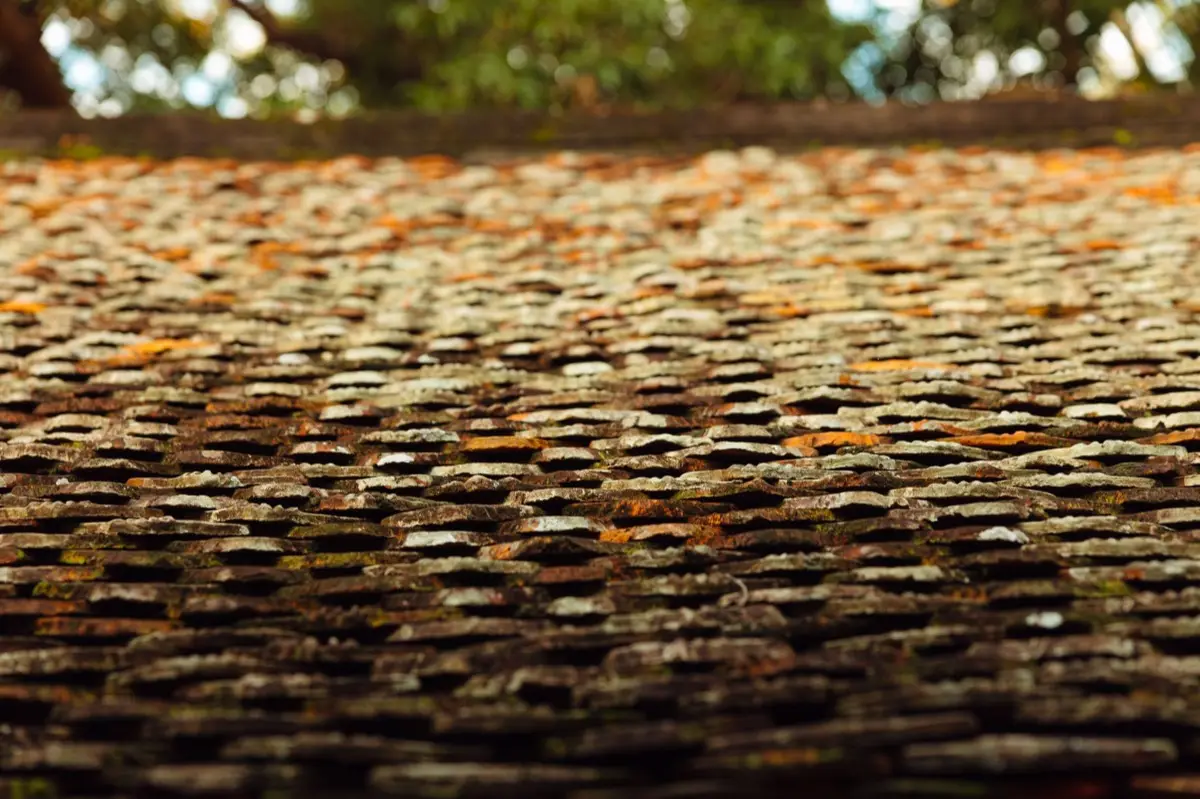
Three different things grow on an asphalt roof, they look like one complaint, and only one of them has a mechanism for shortening the roof's life.
The shingle manufacturers' own trade body splits it. The Asphalt Roofing Manufacturers Association gives algae a whole technical bulletin written purely in the language of appearance — discoloration, staining, pigment. On moss it changes register: moss "can be detrimental to asphalt shingle performance." Same body, same roof, a line drawn. Most companies quoting to clean it do not draw one.
Telling them apart from the ground
| What you see | What it is | What it does |
|---|---|---|
| Green or brown cushions sitting in the shingle laps, thickest on one slope | Moss — a non-vascular plant that, as ARMA puts it, "obtains water through its leaves" rather than through roots | The only one with a damage mechanism |
| Dark brown to black streaks running down the slope | Blue-green algae, most often Gloeocapsa magma | Stains; no sourced damage |
| Flat, crusty, gray-green patches stuck hard to the granules, roughly circular | Lichen — not a plant at all | Contested, and the tier-one source says leave it |
The distance test: streaks run, moss sits, lichen sticks. Oregon State adds a fourth look-alike nobody names — liverworts — and dismisses it: they "rarely require any management."
Moss growth on a roof is the one with a mechanism
ARMA gives two effects and stops. Moss lifts or curls what it calls "the leading edges of the shingles," raising "the risk of shingle blow-off during wind events," and severe buildup can produce "lateral water movement resulting in moisture damage to the roof deck or may even cause leaks." Oregon State's Solve Pest Problems guide grades the property risk high and says moss "slows or prevents water flow off the roof" and "can contribute to shingle damage."
Read what is missing: nothing eats the shingle. A shingle roof works only while water keeps moving down it, and moss holds water in the laps and wedges the laps open. Water that stops moving finds a sideways path. That is the whole argument, and it is enough — OSU's answer to "what if I do nothing" is that moss "may reduce the lifespan of your roof" and that ignoring it means "additional water damage to repair when you replace the roof," a more expensive conversation than how long a roof normally lasts.
Which is why the removal method matters more than the removal. That method, the dilutions, the pressure-washing verdict and the cost are covered in full here, and deliberately not repeated.
Lichen is where the published advice splits
Oregon State, updated 28 May 2026: "Lichens look similar to mosses, but are not plants. Lichens tend to grow more slowly than mosses. Unlike moss, they don't contribute to wood or composite shingles damage." It files lichen under helpful: they "are usually not a problem and can be left alone."
Roof-cleaning copy says the reverse — lichen roots into the shingle mat and tears granules out. We could not find that claim in a single extension publication, trade bulletin or manufacturer document. It is not therefore false — a lichen grips harder than moss, and anything gripping granules that hard comes off with granules attached — but it is unsourced, and the direction of the error is convenient for whoever is quoting. The manufacturers hedge a third way: both warranties below exclude lichen by name, which is liability rather than biology. Lichen's clearest risk is the risk of taking it off.
Black algae on a roof, and what algae-resistant actually buys
ARMA's Algae Discoloration of Roofs, revised June 2024, names Gloeocapsa magma as "probably the most prevalent of several algae species," all "transported through the air," turning light-colored roofs "dark brown or black" either "uniform or as streaks." The geography inverts moss's: "most widespread in the Gulf States and along the Northwest and Eastern Seaboards," anywhere "subjected to warm, humid conditions." And "almost all types of roofing systems are susceptible," so it is not a shingle defect.
Roof algae treatment is the same chemistry as moss — dilute sodium hypochlorite, gently dispersed, rinsed, set out with the dilutions and dwell times here — with one caveat the bulletin volunteers and the sales call does not: "the effectiveness of such cleaning is only temporary, and the discoloration may recur." Price the recurrence, not the visit.
The other defense is bought at reroofing time and is narrower than the label suggests. Owens Corning's US Standard Product Limited Warranty covers AR shingles against "brown-black staining caused due to growth of blue-green algae (primarily the cyanobacteria Gloeocapsa magma)," then: "We do not cover the effects of other growth, such as mold, lichen and green algae." Labor is covered in year one only, prorated after. GAF's Shingle & Accessory Limited Warranty covers StainGuard-labeled shingles against "blue-green algae (also known as cyanobacteria)" and excludes "fungus, mold, lichen, algae" beyond that.
Moss appears in neither coverage. An algae-resistant shingle is an anti-Gloeocapsa shingle, not a moss-resistant or lichen-resistant one. If you have seen broader wording quoted — "algal, fungal, lichen, or cyanobacterial growth" — that is Owens Corning's international warranty, a different document with a five-year AR period. Check which one applies before paying the upgrade to solve a moss problem.
Why it grows where it grows
ARMA: "In North America, moss tends to grow on north facing roof planes" — the ones that "receive less direct sunlight and stay damp longer than south facing planes." The second variable: "overhanging tree branches provide additional shade and drop debris on the roof that further holds in moisture and acts as a food source for moss." Oregon State's caption on its own photograph is blunter — "the conifer branch in the photo sheds needles and shades the roof. These factors lead to moss problems."
The pattern is therefore diagnostic. Growth that stops at a straight line is following a shadow, and something casts it — which killing the growth does not move.
What time of year to remove moss from a roof
Two constraints pull against each other, and the answer is where they overlap.
- The chemistry wants live moss. Washington State University's Hortsense fact sheet, last reviewed August 2025: "Apply once the moss is growing most actively" — and mosses "grow vigorously in the cool, moist weather of fall, winter, and spring."
- The application wants dry weather. Oregon State: do not apply "when it's raining or when rain is expected in the next 24 hours," because mossicides "wash off surfaces during rainfall."
An OSU Extension answer from October 2022 puts both halves in one sentence: treat "when the moss is actively growing, and also during a dry spell when it will not rain more than a 1/2 inch over the next few days."
That rules out both obvious slots. Midsummer treats moss that is dormant and dry, so it absorbs nothing. Midwinter rinses the product into the storm drain, off a wet, mossy, slippery roof — the fall hazard OSU gives a whole panel to. What is left is a dry stretch in spring, or one in early fall before the wet season sets in. Which months those are depends on your climate: the rule travels, the dates do not.
Debris runs on a separate, simpler schedule — OSU says "remove debris before rain," so after the leaves and needles drop, annually, growth or no growth. And budget for the tail: dead moss still has to come off, weather takes weeks, and that is the part of the job that surprises people.
Prevention that is not a zinc strip
- Trim. ARMA: "trimming tree branches back to allow more sunlight to reach the roof." OSU: "remove or thin overhanging tree branches and vegetation that shade the surfaces you are maintaining." The only measure here that changes the condition rather than the symptom.
- Clear debris, keep water moving. ARMA: debris "should be cleared regularly," and "keep gutters clean to promote proper water drainage." A slope that drains properly dries faster — the same argument as fixing where the downspouts discharge.
- Do not let attic ventilation ride along on the quote. Nothing in ARMA's or Oregon State's moss guidance connects attic ventilation to growth on the outside of the roof. Ventilation governs what happens under the deck — worth doing on its own merits, not as a moss remedy.
- Change the material, if you are reroofing anyway. OSU: "Moss doesn't grow easily on metal roofs. Metal is too slippery for moss to take root." A reroofing decision, not a maintenance one.
- Zinc strips are the popular answer and the weak one. OSU files them under "Zinc Strips Are Not Recommended" and says installing them is "not effective to eliminate moss." The full case against retrofitting them sits in the treatment post.
When a diagnosis stops being a wash and starts being roofing work in Alabama
Most of this ends in a cleaning. Some ends in shingle replacement, because moss sat in the laps long enough to lift and curl them — and that crossing point matters, because a wash sits under whatever dollar figure or permit trigger a state uses to decide who may do the work, and shingle work usually does not. Where Alabama draws that line, and whether it credentials roofing at all:
The credential to ask for is a roofers license from the Home Builders Licensure Board, and it starts at two thousand five hundred dollars - far below the ten thousand that triggers a full residential builder license. No exam is required: board rules let a roofer qualify by manufacturer certification alone. If storm damage reached your trusses, the job crosses into a full unlimited license instead. An unlicensed builder cannot maintain any action to enforce your contract.
Ask whoever is diagnosing the growth which side of that line they sit on, and who actually does the shingle work if it comes to that.
Bottom line
Identify before you treat. Moss sits in the laps on the shaded slope, holds water, lifts shingle edges, and is worth acting on. Black algae streaks down the slope and is a pigment problem — worth acting on if the look bothers you, since ARMA never claims it harms anything. Lichen sticks flat and, per Oregon State, can be left alone. Treat inside the growing season on a dry forecast, clear debris before the rain every year, and cut back whatever casts the shade. An algae-resistant shingle does none of that for you.
Auburn AL Roof Pros handles documented roof inspections, asphalt shingle work and roof replacement across Auburn and the Auburn-Opelika metro area. Call (844) 638-2423 and we will tell you which of the three you have before anyone quotes to remove it.
Ready for a free quote in Auburn?
Auburn AL Roof Pros — free estimate, clear scope, no pressure. Use the form on this page or jump to the homepage quote.
Related services in Auburn
Auburn AL Roof Pros money pages — go straight to the service you need.
- Roof Replacement →
A replacement in Auburn is a scheduling problem wearing a roofing problem's clothes. Which shingle you pick matters far less than how many consecutive days somebody can be out from under it, and getting that order backwards is what turns an ordinary job into a bad month.
- Roof Inspections →
An inspection is not a sales visit here; it is a detection system standing in for the one this city does not have. Where a roof shelters somebody who both notices trouble and can act on it, problems surface early.
- Asphalt Shingle Roofs →
Asphalt shingle covers almost everything sloped in this market, and the single most consequential decision about it in Auburn is not the brand. It is the month.
- Roof Leak Repair →
Most leaks we are called out to in this city are reported by somebody who cannot authorize the repair. A resident photographs the ceiling stain, sends it to a management company, and the person who owns the building hears about it a day or two later from another state.
- Storm Damage Restoration →
East Alabama's severe weather arrives in spring, and spring is the half of the year when every building in Auburn is full. That single collision decides how a storm job here actually runs, and it is why the sequence we use differs from the one a coastal crew would use.
Frequently asked questions
Why is there moss on only one side of my roof?
Because that side stays wet longer. The Asphalt Roofing Manufacturers Association puts it plainly: in North America, moss tends to grow on north facing roof planes - the ones that get less direct sunlight and stay damp longer than the south facing ones.
Oregon State's Solve Pest Problems guide says the same from the other end - moist, shady rooftops are ideal for moss growth. So the pattern on your roof is a map of shade and drying time, and the second half of the map is usually a tree.
ARMA notes that overhanging tree branches provide additional shade and drop debris on the roof that further holds in moisture and acts as a food source for moss. If the growth stops at a line, go outside and find what casts that line.
Is moss actually damaging the roof, or is that a sales line?
There is a real mechanism, and it is narrower than the pitch. ARMA's guidance is that moss lifts or curls the leading edges of the shingles, raising the risk of blow-off in a wind event, and that severe buildup can produce lateral water movement resulting in moisture damage to the roof deck or may even cause leaks.
Oregon State grades the property risk as high and says moss growth slows or prevents water flow off the roof and can contribute to shingle damage. Note what neither source says: nothing eats the shingle. Moss holds water on a surface engineered to shed it and jacks the laps open.
That is enough, and it is also the whole of it.
Should I remove lichen from my roof?
The published advice genuinely splits, and the tier-one source is the more relaxed one. Oregon State's Solve Pest Problems guide, updated 28 May 2026, says lichens look similar to mosses but are not plants, tend to grow more slowly, and - unlike moss - they do not contribute to wood or composite shingles damage.
It files them under helpful and says they are usually not a problem and can be left alone. Roof-cleaning marketing says the opposite, that lichen roots into the shingle mat and pulls granules with it. We could not find that claim in any extension publication, trade bulletin or manufacturer document.
A lichen does grip harder than moss, which is exactly why scraping one off takes granules with it. The clearest risk lichen carries is the risk of removing it.
What time of year should moss be removed from a roof?
A dry stretch inside the growing season, which in most climates means spring or early autumn rather than midsummer or midwinter. Two constraints pull against each other. Washington State University's Hortsense fact sheet says to apply moss control once the moss is growing most actively, and mosses grow vigorously in the cool, moist weather of fall, winter, and spring.
But Oregon State says not to apply when it is raining or when rain is expected in the next 24 hours, because mossicides wash off surfaces during rainfall.
An OSU Extension answer from October 2022 puts both halves together: apply when the moss is actively growing, and also during a dry spell when it will not rain more than half an inch over the next few days. Clearing debris is a separate calendar - OSU says remove debris before rain, so after leaf and needle drop.
Do algae-resistant shingles prevent moss?
No, and the warranties say so in writing. Owens Corning's US Standard Product Limited Warranty covers AR shingles against brown-black staining caused due to growth of blue-green algae, primarily the cyanobacteria Gloeocapsa magma, then adds that we do not cover the effects of other growth, such as mold, lichen and green algae.
GAF's Shingle and Accessory Limited Warranty covers StainGuard-labeled shingles against blue-green algae, also known as cyanobacteria, and its exclusion list rules out fungus, mold, lichen, algae other than that. Moss is not named in either coverage. An AR shingle is an anti-Gloeocapsa shingle: it is not moss-resistant and, by name, not lichen-resistant.
Does black algae shorten the life of the shingles?
Nothing we could source says so. ARMA's Algae Discoloration of Roofs bulletin, revised June 2024, is written entirely about appearance - discoloration, staining, pigment - and never claims the organism harms the roof, which is notable given ARMA speaks for the companies that make the shingles and does say elsewhere that moss can be detrimental to asphalt shingle performance.
The bulletin also notes that almost all types of roofing systems are susceptible, so it is not a shingle defect. The common claim that dark algae raises cooling costs by absorbing heat is not in any tier-one document we opened; treat it as unverified rather than as a reason to book a cleaning.
Local context
How this applies in Auburn, AL
Every article here is written from roofing work done in Auburn and the Auburn-Opelika metro area, so the numbers reflect local labour, permit and material costs rather than a national average. Your own job can land either side of them depending on access, the condition of what is already there, and the materials you pick — deck surface temperature read before the first bundle is opened, tabs hand-sealed with asphalt cement on shaded winter slopes, batten-strip tarps screwed down through to the rafter line.
The way to turn any of this into a real answer is to have someone look at your actual situation. The free estimate is free, itemized and written down, with no deposit and no obligation. Call (844) 638-2423 or start on the Auburn AL Roof Pros homepage.
Areas Auburn AL Roof Pros covers
Auburn first, then the surrounding communities of the Auburn-Opelika metro area. Each has its own page with local detail rather than a copy of this one:
- Opelika, AL — Lee County, population 30,995 at the 2020 census
- Phenix City, AL — Lee and Russell counties, population 38,816 at the 2020 census
- Smiths Station, AL — Lee County, population 5,384 at the 2020 census
- Loachapoka, AL — Lee County, population 160 at the 2020 census
- Notasulga, AL — Lee and Macon counties, population 914 at the 2020 census
- Waverly, AL — Chambers, Lee and Tallapoosa counties, population 159 at the 2020 census
Or jump to the full list of Auburn services.
More from the Auburn AL Roof Pros blog
- Insurance Claim for a Roof in Auburn, AL: How the Process Actually Runs
Not whether you are covered — what happens after you call. The adjuster's scope, the depreciation you have to go back and collect, appraisal, and what a public adjuster costs in Auburn, AL.
- Ice Dam Removal in Auburn, AL: One Method Works, Four Wreck the Roof
Steam takes an ice dam off a Auburn, AL roof without damaging it. Chisels, pressure washers, salt and flame do not.
- How Long Does a Tile Roof Last in Auburn, AL? Two Numbers, Not One
Tile outlives the membrane under it by decades, so a tile roof has two lifespans. What clay, concrete, the underlayment and cedar shake really last in Auburn, AL.
The Auburn AL Roof Pros Team
roofing specialists serving Auburn, AL
Written by the Auburn AL Roof Pros team — insured roofing pros serving Auburn, AL and the surrounding area.